NetSuite for the mid-market
NetSuite was founded in 1998 to run business software in the browser, and it has done so ever since. We read it as a tower of three levels: the architecture at the base, the platform above it and the operating model on top. Here is how they fit together, which companies NetSuite fits and where it falls short.
Born in the browser, backed by Oracle's founder
Evan Goldberg spent eight years in product development at Oracle. In 1998 he and Larry Ellison, Oracle's founder, set up the company as NetLedger. Goldberg credits Ellison with the idea: accounting for small businesses, on the web.
The first product went live in 1999, on the Oracle database, at a time when business software was installed on each customer's own servers. A web store followed in 2000, in the same system as the books. In 2002 came the full suite, and in 2003 the company took its name, NetSuite.
Ellison financed the company and remained its largest shareholder until Oracle bought NetSuite in 2016, for about USD 9.3 billion. Oracle calls NetSuite the first cloud company. It was certainly among the first to deliver business software over the internet, and everything else on this page follows from that choice.
NetSuite today: from start-up to IPO
Oracle counts more than 44,000 NetSuite customers, and many have grown up on it. Since 2020, NetSuite customers have gone public 307 times, through an IPO or a SPAC. And 61 % of the technology companies that went public since 2011 were NetSuite customers, again by Oracle's count.
That range is the point. Each industry edition starts with templates for its processes, and configuration fits NetSuite to the company. A company that grows moves up a service tier, from Standard to Ultimate, and keeps the same system.
Oracle offers NetSuite for dozens of industries, from wholesale, retail and manufacturing to professional services and software. Our own view is narrower. In our experience, NetSuite is strongest in four areas:
- Revenue recognition under IFRS 15 and ASC 606, with Advanced Revenue Management
- Subscription billing, with SuiteBilling
- The financial close, with consolidation across subsidiaries
- Project management, from resource planning to billing
Beneath these strengths lies the platform. NetSuite is a platform built for the internet, with the suite on top, not a suite that moved to the web later. It is extended with the tools of web development, and its architecture is built to scale. In our view, that is why it has not simply been copied: a platform like this works only when it is part of the design from the start. The tower in the next section shows how it is built.
The NetSuite tower
We draw NetSuite as a tower of six layers. Each layer rests on the one below it, and every customer gets the same tower:
Reporting
One version of the truth, live: a figure on a dashboard is the figure in the ledger.
- Real time
- Dashboards
- One interface
- One database for everything below
Business areas
Every process posts to one general ledger, without interfaces in between.
Front office · Order to cash · Procure to pay · People and projects
- Marketing
- CRM
- Sales force automation
- eCommerce
- Order management
- Billing
- Revenue recognition
- Procurement
- WMS
- Projects
- HCM
Global enterprise
One instance for every entity, consolidated under IFRS or US GAAP.
- Multi-subsidiary
- Multi-currency
- Multi-language
- Consolidation and eliminations
- Global roles and permissions
Applications
Standard first; add-ons only where they earn their place.
- Core
- Advanced modules
- SuiteApps
Platform
Modules of your own, without forking the product.
- SuiteBuilder
- SuiteFlow
- SuiteScript
- SuiteTalk
- SuiteAnalytics
Infrastructure
One release for every customer, twice a year.
- Multi-tenant
- PCI DSS
- SOC 1 and SOC 2
- Disaster recovery
- Sandbox
- No version lock
The sections below follow the tower from the bottom up: the architecture, the platform and the operating model.
Architecture: Oracle's database, Java, the browser
NetSuite has run on the Oracle database since its first release, and it is moving to Oracle Autonomous Database. In our view, only PostgreSQL, the database under Odoo, challenges Oracle's database today in scale and scope.
The server side runs on Java, with the scalability and reliability that made Java a standard for enterprise systems. Since 2023 it has run on Oracle GraalVM, across more than 10,000 application servers.
Customisations are written in JavaScript, as SuiteScript, and run on the same platform. The front end is plain HTML and supports every standard web component. The one thing Oracle does not support, at least officially, is a script that reaches into the page structure itself (the DOM). Scripts go through SuiteScript instead, which is one reason customisations survive the next release.
SuiteScript has had only two generations in twenty years: 1.0, in use by 2006, and 2.x since 2015. Code written for 1.0 still runs today. Oracle is only now retiring it: from release 2027.1 it gets critical fixes only, and from 2028.2 every script is to be 2.1.
Platform: one database, roles and SuiteCloud
For twenty years, NetSuite kept all of a company's data in one database: customers, orders, stock, projects, employees and the general ledger. A report can combine any of them without an interface in between.
The core still works that way. Around it, the unity has thinned: four areas now run as separate Oracle services, linked to NetSuite by connectors:
- Budgeting: NetSuite Planning and Budgeting, on Oracle EPM
- Advanced project management: SuiteProjects Pro, formerly OpenAir
- The financial close: NetSuite Account Reconciliation and NetSuite Close Management and Consolidation, on Oracle EPM
- Data warehouse reporting: NetSuite Analytics Warehouse, on Oracle Analytics Cloud
They are integrated, but they are no longer the one database.
NetSuite core
NetSuite SuiteProjects Pro
SuiteProjects Pro
Formerly OpenAir
Advanced PSA
A separate professional services automation application, formerly OpenAir. Native NetSuite projects stay in the core; SuiteProjects Pro sits beside it.
- Projects and resources
- Time and expenses
- Services billing
- Projects and resources
- Time and expenses
- Services billing
- Separate PSA application
The integration exchanges supported records in both directions: on a schedule, on demand, or in real time where supported. Oracle hosts every SuiteProjects Pro account on OCI.
NetSuite CPQ
CPQ
Formerly Verenia
Native SuiteApps
NetSuite CPQ, formerly Verenia CPQ, is installed in the NetSuite account as managed SuiteApps. It belongs to the core’s SuiteApps and is drawn beside the tower for clarity.
- Configurator
- Guided selling
- Proposal generator
- Manufacturing
- Commerce integration
- Configurator and guided selling
- Proposal generator
- Manufacturing and commerce
- Within NetSuite
NetSuite Analytics Warehouse
Analytics Warehouse
Cross-source analytics
Data and analytics
A separate analytics service that loads NetSuite data into its own warehouse, with Oracle Analytics Cloud, data pipelines, a semantic model and ready-made analytics.
- Oracle Analytics Cloud
- Autonomous AI Lakehouse
- NetSuite and other data
- Oracle Analytics Cloud
- Semantic model and content
- Autonomous AI Lakehouse
- Data pipelines
Refresh schedules decide how current its data is, so it is not the core’s live database; SuiteAnalytics inside NetSuite is a different thing.
NetSuite Planning and Budgeting
Planning and Budgeting
Financial planning
Cloud EPM
A planning application in Oracle Cloud EPM, with its own planning data, connected to NetSuite through SuiteApps and EPM data integration.
- Planning and forecasting
- Scenario models
- Oracle Cloud EPM
- Planning and forecasting
- Scenarios and budgets
- Oracle Cloud EPM
- Separate planning data
Budgets return to NetSuite through a configured import, not through a shared database.
Oracle Cloud Infrastructure (OCI)
Oracle Cloud Infrastructure
OCI
The common cloud foundation under the NetSuite core and the connected services.
- Compute
- Storage
- Networking
One infrastructure provider: not a shared tenancy, database, region or release cycle.
Access follows roles. Each role opens a Center, NetSuite's name for the set of pages a user sees: for accounting, sales, marketing, projects or support, and limited ones for employees, customers, vendors and partners.
SuiteCloud: modules of your own
Above the applications sits SuiteCloud, the customisation layer. It is large enough to build entire modules of your own:
- SuiteBuilder: your own fields, records and forms, by point and click
- SuiteFlow: workflows and approvals, drawn rather than programmed
- SuiteScript: JavaScript on the server and in the browser, including pages of your own (Suitelets) and web service endpoints of your own (RESTlets)
- SuiteTalk: REST and SOAP web services for integration; SOAP is being retired and stops working with release 2028.2
NetSuite adopted low code early, long before the term was common, and it is still among the most intuitive platforms to configure.
Example: the QuickBooks home page in NetSuite
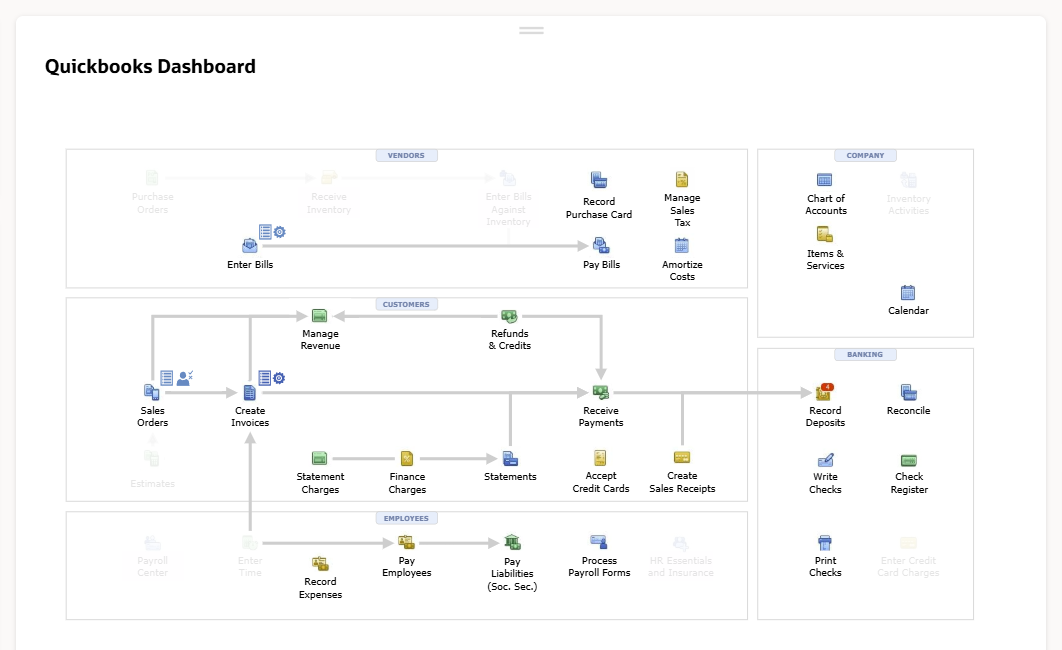
Many finance teams know the QuickBooks home page: a map of the daily work, from bills to payments, with one click per step. We brought that map into the NetSuite dashboard as an interactive portlet.
It is a simple iframe on the dashboard, with a Suitelet behind it that handles the requests. It took us less than an hour.
Reporting on live data
Reporting comes built in. Saved searches, reports, SuiteAnalytics workbooks and dashboards read the live data, so a figure on a dashboard is the figure in the ledger. In our experience, no other ERP in its class comes close to what NetSuite reports out of the box.
Operating model: one release for every customer
The cloud is not only where NetSuite runs. It shapes how NetSuite is sold, introduced, localised, supported and upgraded:
- By industry: NetSuite is sold in industry editions, with a strong focus on services companies.
- By size: service tiers from Standard to Ultimate set the number of users, the storage and the transaction volume.
- SuiteSuccess: Oracle's method for a fast introduction, since 2017. Each industry edition starts with predefined roles, dashboards, key figures, reports and forms, and goes live in stages.
- Localisation: country requirements come as SuiteApps on the same platform, not as national versions.
- Support built in: help and support cases are reached from inside NetSuite. A sandbox, a copy of production, can be refreshed to review a change, and a Release Preview account shows the next release before it arrives.
- Two major releases a year, and every customer is upgraded, in stages. Nobody stays on an old version.
- Marketplace: partners build on the same platform and sell their SuiteApps on SuiteApp.com, after a Built for NetSuite review that is renewed with every major release.
Localisation in Europe
Oracle concentrates its own localisation in Europe on the markets it considers core: the UK, Germany, the Netherlands and France. Elsewhere, European partners complement the offering with SuiteApps of their own.
For Switzerland, we have the localisation at hand. For Spain, Portugal, Italy, Poland, Austria, the Czech Republic, Hungary, Serbia, Slovenia, Greece and other countries, we work with partners, for example on tax compliance and bank integration.
NetSuite Next: intelligence where the data and the controls are
NetSuite Next, which Oracle announced in October 2025, takes the concept further. It brings an assistant that answers in plain language, and agentic workflows for payment proposals, reconciliations and supplier selection, inside NetSuite. Its rollout began in the US and Canada with release 2026.2; Oracle has not yet given a date for Europe.
Outside AI connects through Oracle's AI Connector Service, built on the Model Context Protocol (MCP). It sees only what the user's role may see, and it cannot act as an administrator.
This is where the platform concept becomes tangible. Intelligence can only grow where the data and the controls live together. An AI that reads the ledger but ignores who may approve what is a risk, not an assistant.
Who NetSuite fits
NetSuite is the right system for an international company that reports under IFRS or US GAAP and wants consolidated reporting, eliminations included, in one platform. Subsidiaries, currencies and parallel sets of books are standard.
One limit: minority interests are not consolidated natively. They need NetSuite Close Management and Consolidation, a separate service built on Oracle EPM.
For software vendors and financial service providers in that position, NetSuite is our go-to system.
How we work with software vendors
Where it falls short
In our experience, NetSuite is weaker where the work is physical and runs as projects: production, construction and engineer-to-order. Outside the US it is also weaker in retail: its point of sale is not offered in Switzerland, Germany or Austria.
Payroll is a gap as well. NetSuite's own payroll, SuitePeople Payroll, is for employees in the United States, so payroll in Switzerland, Germany or Austria needs a separate solution.
Is NetSuite the right platform for you?
Tell us how your company is organised and where it is heading. We will tell you whether NetSuite fits, and where it would not.